title 'The Difficulty of Flying the Alleged 757 Down the Hill -' contains 8 files, 42 entries, 4 unique posts

SPreston
post Mar 16 2008, 11:45 PM
Post #1


Patriotic American


Group: Respected Member
Posts: 518
Joined: 14-May 07
From: Where I am standing on the RUINS of the 9-11 OFFICIAL STORY
Member No.: 1,045


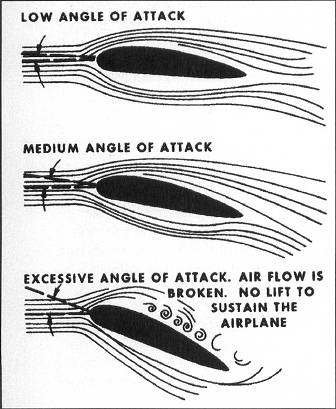
Assuming for the moment that Hani Hanjour was actually at the Pentagon and in the cockpit flying that 757 aircraft down the hill into the light poles, he must have been in a panic. It would seem his aircraft was out of control. His target the Pentagon was on a higher trajectory and he needed to avoid the light poles and the ground. Hani needed to pull up to a level flight path across the lawn. Hani couldn't just jerk back wildly on the yoke, because too much elevator and too much pitch would pull the aircraft nose up into an unrecoverable stall. At 530 mph and close to the ground, there was no time to correct an error. From the #1 light pole, the distance to the alleged Pentagon impact point was 1016 feet. At 777 fps the flight time would be 1.3 seconds. Not much time for poor Hani to fiddle around.

QUOTE
Stalls can occur at higher speeds if the wings already have a high angle of attack. Attempting to increase the angle of attack at 1g by moving the control column back simply causes the aircraft to rise. However the aircraft may experience higher g, for example when it is pulling out of a dive. In this case, the wings will already be generating more lift to provide the necessary upwards acceleration and so there will be higher angle of attack. Increasing the g still further, by pulling back on the control column, can cause the stalling angle to be exceeded even at a high speed.

Aircraft movement or inertia parallel to relative wind - elevator pitching aircraft nose up - wing angle to relative wind increasing


So Hani allegedly pulls back on the yoke delicately and the nose starts to rise and the aircraft slams through all 5 light poles damaging the wing aerodynamic surfaces. Now what? The aircraft has lost lift and is pitching up less. If Hani does nothing the aircraft will hit the ground. If Hani pulls up too much, the wings will stall and the aircraft will hit the ground. Wanna bet that Hani was real glad he was nowhere near the Pentagon and not in the cockpit of that fantasy aircraft?

Wing approaching stall - aircraft inertia parallel to relative wind - aerodynamic airflow around wing - nose pitched up and wing angle to relative wind increasing


This scenario would be similar with a highly skilled remote pilot flying the aircraft into the Pentagon. Just fly it down the hill and straight into the Pentagon 1st floor. But why would he fly his very vulnerable aircraft wings through 5 light poles? That seems terribly risky. Same difficulties Hani encountered. He could have supposedly flown directly along the -5 degree descent angle provided by the FDR data straight into the Pentagon first floor. Why didn't he? Those stupid light poles really screwed everything up. Whose idiotic idea was that?
Dubya, is that why you were hiding out in Florida?

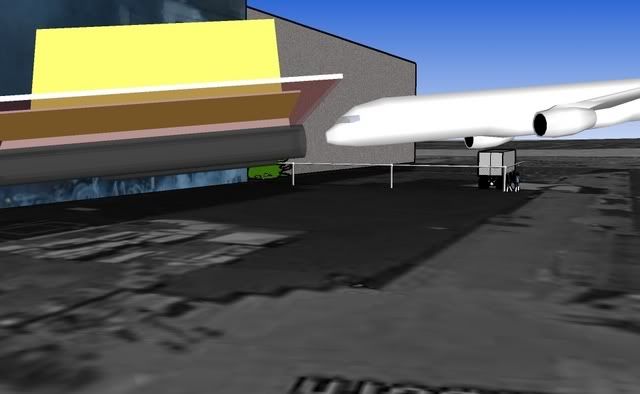
The -5 degree flight descent the fantasy aircraft should have taken to the Pentagon 1st floor


Go to the top of the page
 
+Quote Post
SPreston
post Mar 16 2008, 11:58 PM
Post #2


Patriotic American


Group: Respected Member
Posts: 518
Joined: 14-May 07
From: Where I am standing on the RUINS of the 9-11 OFFICIAL STORY
Member No.: 1,045


Hani Hanjour or the remote pilot are in a dilemma. Their alleged 757 aircraft is rushing down the hill towards the light poles at 777 fps (530 mph). Presumably they pull back on the yoke at some point in their descending flight path to generate some reaction lift to their aircraft in order to pull up and miss the light poles and end up in a level flight path to the Pentagon. But they do not have much time because the distance of 1016 feet from the #1 light pole to the Pentagon wall will be traveled in only 1.3 seconds. However the aircraft does not pull up yet and strikes the #1 and #2 poles damaging both wings. Another dilemma. To pull back more on the yoke to generate more reaction lift might stall the aircraft giving no lift at all. Gravity (1G) is also acting against the lift, pulling the aircraft downward. A much more serious problem arises as the wings smash through 3 more light poles. Increased reaction lift will also tremendously increase the force on the damaged wings, possibly resulting in the failure of one or both wings and gravity winning and pulling the aircraft to the ground. The pull up from the descent is also adding gravitational force (many Gs) to the damaged wings.

Whyever did they foolishly decide to add the light poles to the fantasy aircraft simulation? They make no sense at all. Why make their Pentagon skit with magicians' tricks so overly complicated? The greatly increased chance of failure is apparent to all investigators. The bungled planted light poles was carried out by totally inept clowns.

The straight into the wall -5 degree FDR descent would have been so much better. Then they might have fooled all of us. rolleyes.gif

Bernoulli Lift


Reaction Lift


QUOTE (Bernoulli Lift - Reaction Lift)
AERODYNAMIC LIFT
When a wing is propelled through the air, there is a force upward on the wing due to the Bernoulli effect (air passing more quickly over the top of the wing than the bottom of the wing produces a lower pressure on the upper surface, hence a lift). There is also an upward force due to the air deflected downward from the bottom of the wing. These two forces taken together tend to lift the wing against gravity and is therefore known as LIFT.
QUOTE

The four main forces acting on an airplane are lift, drag, gravity, and thrust. All of
these forces have effects on the performance of the airplane.

Lift:
Lift is created by the airfoil. It is what allows the aircraft to fly. Most of the lift
created by the airfoil can be attributed to Bernoulli's Principle. The rest of lift is
created by the impact of air against the lower surface of the wing. The amount of lift
is in a direct relationship with the speed of the airplane. As it increases speed, the
amount of lift acting upon it increases. Lift can also be manipulated by increasing or
decreasing the angle of attack, but if the angle of attack is increased too much the
aircraft will stall
.
Drag:
Drag is the force which opposes the forward motion of the aircraft. There are two
kinds of drag inducing drag and parasite drag. Inducing drag is caused by the
development of lift while Parasite drag is the result of all of the un-aerodynamic
features of the airplane.
Gravity:
Gravity is the force that pulls the aircraft, and everything else, towards the earth.
to fly, the force of lift has to exceed the force of gravity.
Thrust:
Thrust is the force which opposes drag. For the aircraft to move forward, thrust
must be greater than drag.

These four forces can be divided into two groups of opposing forces. Lift opposes gravity,
and thrust opposes drag. Also, according to Bernoulli's Principle, as the speed of the aircraft
increases so does the amount of lift.

Note that Bernoulli Lift is the effect in modern day sailboats which allows them to sail up wind and closely into the wind. As long as they are not using any engines, their power and speed upwind is generated solely by the Bernoulli Effect.

QUOTE (Aerodynamic Lift - Bernoulli Effect - Reaction Lift)
* Reaction Lift is the effect of the pressure of moving fluid (air, in this case) against the bottom of a tilted surface. Newton described action and reaction, and this is an example. The air which hits the bottom of that tilted surface is deflected downward (action), which creates an equal and opposite reaction, upward lift, in the wing itself. From a reference point on a wing (airfoil) on a moving aircraft, the air appears to be moving, and it creates an equal pressure against any and all surfaces of an aircraft. If you stick your hand out the window of a moving car, you can feel this pressure. If you hold your hand vertically, where you are completely blocking the wind, you will feel the greatest pressure, what is technically called the stagnation pressure. The stagnation pressure is easy to calculate as it represents a simple example of Newton's Conservation of Energy, in this case changing the kinetic energy of the air's motion into pressure energy. It is given by 1/2 * (rho) * velocity2 where rho is the density of the air.
In the case of your hand in the car, if the car is traveling at 60 mph (to the air and not necessarily the ground) (which is 88 ft/sec), then the stagnation pressure is: 1/2 * (1/13 pound/cu.ft) * (88)2 / 32, or about 9.3 pounds per square foot. (the 32 was necessary to convert the weight in the density into a mass unit, 32 being the acceleration due to gravity). The actual pressure on your hand is a little higher than that, because air that had hit the windshield also has to move past the area where your hand is, and so the actual pressure there is higher.

If, instead of holding your hand vertically, you tilt it forward, your hand will feel a Reaction Lift. Essentially, air that then hits your angled hand gets deflected downward, giving the air a new downward motion along with its remaining rearward motion. Newton's action-reaction (in an up-down direction) tells us that your hand experiences an UPWARD motion as a result. For small angles of your hand from horizontal, an analysis of the pressures involved is pretty simple. The available stagnation pressure is simply multiplied by the sine of the angle of the tilt from horizontal. For example, if your hand if angled 15° from horizontal out that car window, the Reaction Lift pressure on your hand would be about 9.3 pounds per square foot * (0.2588) or around 2.4 pounds per square foot vertical lift force.

For an airplane flying at 500 mph (730 ft/sec), in the less dense air at 30,000 feet altitude, the stagnation pressure is around 260 pounds per square foot.

The process of Reaction Lift is naturally unstable. If you tilt your hand at more of an angle, there is both a lot more force now pressing against your hand, and it also has greater leverage, so it tends to want to both tilt and raise your hand even more. You have to stiffen your arm muscles to keep that from happening. There actually IS one specific angle where your hand tends to be able to remain (called meta-stable) but a tiny wind gust will quickly upset that temporary stability.

Reaction Lift is sort of a "brute force" lift. It relies on the availability of a lot of (engine) power to create strong windspeeds, since it essentially creates Reaction Lift by deflecting that air downward, which uses up a lot of power. It is also naturally unstable. Because modern aircraft have very powerful engines, all modern large aircraft primarily rely on Reaction Lift for the majority of their total aerodynamic lift.

You may have noticed that Reaction Lift does not depend at all on the actual shape of the wing. A flat board, tilted, creates Reaction Lift as well as any complicated curved airplane wing would. And, of course, the bottom surface of a wing using Reaction Lift MUST be tilted to get the lift effect.

* Bernoulli Lift is entirely different. First, the wing does not need to be tilted! A perfectly horizontal wing (if shaped properly) creates upward Bernoulli Lift. Actually, the most common shapes of wings on modern airliners (called a NACA 4415 shape) creates some UPWARD lift (the upward Bernoulli lift is greater than the downward Reaction Lift) even if the wing is tilted DOWNWARD by several degrees! Second, Bernoulli Lift is not dependent on the tilt of the wing, and it is pretty constant up to a wing angle called the "stalling angle". The fact that Bernoulli Lift is so constant and so reliable, it represents a STABLE type of lift.
Bernoulli Lift is entirely created due to the SHAPE of the wing. The upper surface of the wing is always bulged out more than the lower surface is, which is what actually creates Bernoulli Lift. As described below, Newton's Conservation of Energy causes any fluid flow to have (slightly) lower pressure if it is moving faster. The air that meets the front edge of a wing must get past it, to meet up again after the wing has gone by. The bigger bulge of the top side of a wing (airfoil) means the air has to move a little faster, to cover the longer distance, than air that went under the wing where the path was straighter. Bernoulli Lift is simply the effect of this (slight) difference of pressure above and below a wing. It ONLY depends on the shape of the wing, the velocity of the air and the density of the air. It has no dependence on the angle of the wing to the air motion.

Bernoulli Lift does not require the massive power that is necessary for Reaction Lift. But since large modern aircraft all have powerful engines, great reliance on Bernoulli Lift has faded. The discussion below shows that modern airliners commonly fly with 1/6 Bernoulli Lift and 5/6 Reaction Lift. At lower airspeeds, both types of lift become far less (both depending on the square of the velocity of the air), but massive aircraft can remain in the air by extending "flaps" along the rear edge of the wings and tilting them downward, which greatly increases Reaction Lift. Slow speed performance of the very heavy airliners is therefore especially unstable, which explains why nearly all airliner accidents occur during takeoffs or landings.

People that do not want to believe that Bernoulli Lift even exists tend to claim that the ONLY way that anything could have Lift is if air is "thrown downward". They cite Newton's action-reaction reasoning, and are actually quite correct in describing how Reaction Lift occurs. However, Newton also described many other things to us! Specifically, that there is Energy in any "compressed fluid" which generally means to us either water or air.
http://mb-soft.com/public2/lift.html


This post has been edited by SPreston: Mar 17 2008, 12:01 AM
Go to the top of the page
 
+Quote Post
painter
post Mar 16 2008, 11:57 PM
Post #2


∞* M E R C U R I A L *∞


Group: Respected Member
Posts: 5,871
Joined: 25-August 06
From: SFO
Member No.: 16


Yep, those damn light poles. Whose DUMB idea was that?

Problem is, it is harder to STAGE am impact from the roof and, besides, it would miss all that conveniently reinforced facade.
Go to the top of the page
 
+Quote Post
SPreston
post Mar 16 2008, 11:58 PM
Post #3


Patriotic American


Group: Respected Member
Posts: 518
Joined: 14-May 07
From: Where I am standing on the RUINS of the 9-11 OFFICIAL STORY
Member No.: 1,045


Hani Hanjour or the remote pilot are in a dilemma. Their alleged 757 aircraft is rushing down the hill towards the light poles at 777 fps (530 mph). Presumably they pull back on the yoke at some point in their descending flight path to generate some reaction lift to their aircraft in order to pull up and miss the light poles and end up in a level flight path to the Pentagon. But they do not have much time because the distance of 1016 feet from the #1 light pole to the Pentagon wall will be traveled in only 1.3 seconds. However the aircraft does not pull up yet and strikes the #1 and #2 poles damaging both wings. Another dilemma. To pull back more on the yoke to generate more reaction lift might stall the aircraft giving no lift at all. Gravity (1G) is also acting against the lift, pulling the aircraft downward. A much more serious problem arises as the wings smash through 3 more light poles. Increased reaction lift will also tremendously increase the force on the damaged wings, possibly resulting in the failure of one or both wings and gravity winning and pulling the aircraft to the ground. The pull up from the descent is also adding gravitational force (many Gs) to the damaged wings.

Whyever did they foolishly decide to add the light poles to the fantasy aircraft simulation? They make no sense at all. Why make their Pentagon skit with magicians' tricks so overly complicated? The greatly increased chance of failure is apparent to all investigators. The bungled planted light poles was carried out by totally inept clowns.

The straight into the wall -5 degree FDR descent would have been so much better. Then they might have fooled all of us. rolleyes.gif

Bernoulli Lift


Reaction Lift


QUOTE (Bernoulli Lift - Reaction Lift)
AERODYNAMIC LIFT
When a wing is propelled through the air, there is a force upward on the wing due to the Bernoulli effect (air passing more quickly over the top of the wing than the bottom of the wing produces a lower pressure on the upper surface, hence a lift). There is also an upward force due to the air deflected downward from the bottom of the wing. These two forces taken together tend to lift the wing against gravity and is therefore known as LIFT.
QUOTE

The four main forces acting on an airplane are lift, drag, gravity, and thrust. All of
these forces have effects on the performance of the airplane.

Lift:
Lift is created by the airfoil. It is what allows the aircraft to fly. Most of the lift
created by the airfoil can be attributed to Bernoulli's Principle. The rest of lift is
created by the impact of air against the lower surface of the wing. The amount of lift
is in a direct relationship with the speed of the airplane. As it increases speed, the
amount of lift acting upon it increases. Lift can also be manipulated by increasing or
decreasing the angle of attack, but if the angle of attack is increased too much the
aircraft will stall
.
Drag:
Drag is the force which opposes the forward motion of the aircraft. There are two
kinds of drag inducing drag and parasite drag. Inducing drag is caused by the
development of lift while Parasite drag is the result of all of the un-aerodynamic
features of the airplane.
Gravity:
Gravity is the force that pulls the aircraft, and everything else, towards the earth.
to fly, the force of lift has to exceed the force of gravity.
Thrust:
Thrust is the force which opposes drag. For the aircraft to move forward, thrust
must be greater than drag.

These four forces can be divided into two groups of opposing forces. Lift opposes gravity,
and thrust opposes drag. Also, according to Bernoulli's Principle, as the speed of the aircraft
increases so does the amount of lift.

Note that Bernoulli Lift is the effect in modern day sailboats which allows them to sail up wind and closely into the wind. As long as they are not using any engines, their power and speed upwind is generated solely by the Bernoulli Effect.

QUOTE (Aerodynamic Lift - Bernoulli Effect - Reaction Lift)
* Reaction Lift is the effect of the pressure of moving fluid (air, in this case) against the bottom of a tilted surface. Newton described action and reaction, and this is an example. The air which hits the bottom of that tilted surface is deflected downward (action), which creates an equal and opposite reaction, upward lift, in the wing itself. From a reference point on a wing (airfoil) on a moving aircraft, the air appears to be moving, and it creates an equal pressure against any and all surfaces of an aircraft. If you stick your hand out the window of a moving car, you can feel this pressure. If you hold your hand vertically, where you are completely blocking the wind, you will feel the greatest pressure, what is technically called the stagnation pressure. The stagnation pressure is easy to calculate as it represents a simple example of Newton's Conservation of Energy, in this case changing the kinetic energy of the air's motion into pressure energy. It is given by 1/2 * (rho) * velocity2 where rho is the density of the air.
In the case of your hand in the car, if the car is traveling at 60 mph (to the air and not necessarily the ground) (which is 88 ft/sec), then the stagnation pressure is: 1/2 * (1/13 pound/cu.ft) * (88)2 / 32, or about 9.3 pounds per square foot. (the 32 was necessary to convert the weight in the density into a mass unit, 32 being the acceleration due to gravity). The actual pressure on your hand is a little higher than that, because air that had hit the windshield also has to move past the area where your hand is, and so the actual pressure there is higher.

If, instead of holding your hand vertically, you tilt it forward, your hand will feel a Reaction Lift. Essentially, air that then hits your angled hand gets deflected downward, giving the air a new downward motion along with its remaining rearward motion. Newton's action-reaction (in an up-down direction) tells us that your hand experiences an UPWARD motion as a result. For small angles of your hand from horizontal, an analysis of the pressures involved is pretty simple. The available stagnation pressure is simply multiplied by the sine of the angle of the tilt from horizontal. For example, if your hand if angled 15° from horizontal out that car window, the Reaction Lift pressure on your hand would be about 9.3 pounds per square foot * (0.2588) or around 2.4 pounds per square foot vertical lift force.

For an airplane flying at 500 mph (730 ft/sec), in the less dense air at 30,000 feet altitude, the stagnation pressure is around 260 pounds per square foot.

The process of Reaction Lift is naturally unstable. If you tilt your hand at more of an angle, there is both a lot more force now pressing against your hand, and it also has greater leverage, so it tends to want to both tilt and raise your hand even more. You have to stiffen your arm muscles to keep that from happening. There actually IS one specific angle where your hand tends to be able to remain (called meta-stable) but a tiny wind gust will quickly upset that temporary stability.

Reaction Lift is sort of a "brute force" lift. It relies on the availability of a lot of (engine) power to create strong windspeeds, since it essentially creates Reaction Lift by deflecting that air downward, which uses up a lot of power. It is also naturally unstable. Because modern aircraft have very powerful engines, all modern large aircraft primarily rely on Reaction Lift for the majority of their total aerodynamic lift.

You may have noticed that Reaction Lift does not depend at all on the actual shape of the wing. A flat board, tilted, creates Reaction Lift as well as any complicated curved airplane wing would. And, of course, the bottom surface of a wing using Reaction Lift MUST be tilted to get the lift effect.

* Bernoulli Lift is entirely different. First, the wing does not need to be tilted! A perfectly horizontal wing (if shaped properly) creates upward Bernoulli Lift. Actually, the most common shapes of wings on modern airliners (called a NACA 4415 shape) creates some UPWARD lift (the upward Bernoulli lift is greater than the downward Reaction Lift) even if the wing is tilted DOWNWARD by several degrees! Second, Bernoulli Lift is not dependent on the tilt of the wing, and it is pretty constant up to a wing angle called the "stalling angle". The fact that Bernoulli Lift is so constant and so reliable, it represents a STABLE type of lift.
Bernoulli Lift is entirely created due to the SHAPE of the wing. The upper surface of the wing is always bulged out more than the lower surface is, which is what actually creates Bernoulli Lift. As described below, Newton's Conservation of Energy causes any fluid flow to have (slightly) lower pressure if it is moving faster. The air that meets the front edge of a wing must get past it, to meet up again after the wing has gone by. The bigger bulge of the top side of a wing (airfoil) means the air has to move a little faster, to cover the longer distance, than air that went under the wing where the path was straighter. Bernoulli Lift is simply the effect of this (slight) difference of pressure above and below a wing. It ONLY depends on the shape of the wing, the velocity of the air and the density of the air. It has no dependence on the angle of the wing to the air motion.

Bernoulli Lift does not require the massive power that is necessary for Reaction Lift. But since large modern aircraft all have powerful engines, great reliance on Bernoulli Lift has faded. The discussion below shows that modern airliners commonly fly with 1/6 Bernoulli Lift and 5/6 Reaction Lift. At lower airspeeds, both types of lift become far less (both depending on the square of the velocity of the air), but massive aircraft can remain in the air by extending "flaps" along the rear edge of the wings and tilting them downward, which greatly increases Reaction Lift. Slow speed performance of the very heavy airliners is therefore especially unstable, which explains why nearly all airliner accidents occur during takeoffs or landings.

People that do not want to believe that Bernoulli Lift even exists tend to claim that the ONLY way that anything could have Lift is if air is "thrown downward". They cite Newton's action-reaction reasoning, and are actually quite correct in describing how Reaction Lift occurs. However, Newton also described many other things to us! Specifically, that there is Energy in any "compressed fluid" which generally means to us either water or air.
http://mb-soft.com/public2/lift.html


This post has been edited by SPreston: Mar 17 2008, 12:01 AM
Go to the top of the page
 
+Quote Post
RSS Lo-Fi Version Time is now: 13th November 2020 - 10:00 AM
 
Start new topic
The Difficulty of Flying the Alleged 757 Down the Hill, and Pulling Up to a Level Flight Path Across the Lawn

Reply to this topicStart new topic
RSS Lo-Fi Version Time is now: 15th November 2020 - 03:38 AM
 
Reply to this topicStart new topic
RSS Lo-Fi Version Time is now: 15th November 2020 - 03:39 AM
Posts in this topic
- SPreston   The Difficulty of Flying the Alleged 757 Down the Hill   Mar 16 2008, 11:45 PM
- - painter   Yep, those damn light poles. Whose DUMB idea was t...   Mar 16 2008, 11:57 PM
- - SPreston   Hani Hanjour or the remote pilot are in a dilemma....   Mar 16 2008, 11:58 PM

Source file links:

'index.php-6428.html'

'index.php-67453.html'

'index.php-67455.html'

'index.php-67456.html'

'index.php-67457.html'

'index.php-67460.html'

'index.php-67461.html'

'index.php-67462.html'